MalaBoost
Biosensors · global health · engineering economics
Read this first. MalaBoost is a proposed design. No biosensor has been built and no experimental or clinical data exist. It is not a medical device and makes no sensitivity, specificity or detection-limit claims. Co-developed with Rudra Tiwari.
Rescue a faint line
pick a parasite load, then press the blister
what you’re looking atTwo malaria test strips side by side: pick how many parasites, press the blister, and see if the faint line becomes readable.
TOO FAINT
releases the colour-forming substrate
TOO FAINT
Too faint to call by eye. Press the blister to boost the MalaBoost strip.
- line contrast
- 3.4% → 3.4%
- signal / noise
- 1.9 → 1.9
- “readable” bar
- SNR ≥ 3
An illustrative optical-density model, not a measurement. No strip has been made; loads are uncalibrated. Every parameter as a slider ↓
01 · the question
Can a cheap, press-to-activate chemical step make a faint malaria line readable by eye, without a reader and without inventing lines on blank strips?
02 · where it stands
- strips built or tested: there is no lab data yet
- 0
- median rapid test today (Global Fund, 2009–18); the target is under $1
- $0.47
- competitions entered: Diamond Challenge and Blue Ocean (entries, not results)
- 2
03 · what broke → what’s next
- A darker line isn’t automatically a better test: stain that lands everywhere darkens the background too.
- Nothing is costed yet. Catalyst, blister and assembly all have to fit in roughly 50 cents.
- Food-dye paper-strip experiment: three arms, fixed lightbox, ImageJ grey values, blinded readers.
- Check blank strips for false lines before trusting any gain in contrast.
Read the full write-up10 sections · The accessibility problem, Why HRP2 isn’t enough, Proposed architecture…
The accessibility problem
Malaria is diagnosed at the community level with rapid diagnostic tests: a drop of blood, a paper strip, a line that appears or doesn’t. They work because they need no laboratory, no electricity and little training. The WHO estimates 282 million malaria cases and 610,000 deaths in 2024, mostly in Africa.
The catch is that the result depends on a person reading a line by eye. When a line is faint, two people can read the same test differently.
Why HRP2 isn’t enough
Most rapid tests in Africa detect a parasite protein called HRP2. Some P. falciparum parasites have deletions in the pfhrp2 and pfhrp3 genes and simply don’t make it, so an HRP2 test can say “negative” to an infected person. In one Ethiopian survey of 12,572 people, HRP2 tests were estimated to miss 9.7% of P. falciparum cases because of these deletions.
Tests that also detect a second protein, pLDH, can catch those infections. But at low parasite density the pLDH line tends to be faint. In one study of children with severe febrile illness, a pLDH test’s sensitivity fell to 45.7% below 1,000 parasites per microlitre. That faint line is the specific weakness MalaBoost targets.
Proposed architecture
Keep a standard dual-antigen strip. Label only the pLDH detection antibody with a platinum nanocatalyst. A sealed blister, pressed only when the HRP2 line is absent and the pLDH line is faint, releases a colour-forming substrate and dilute peroxide. Where catalyst has been captured, extra colour forms; where it hasn’t, nothing should.
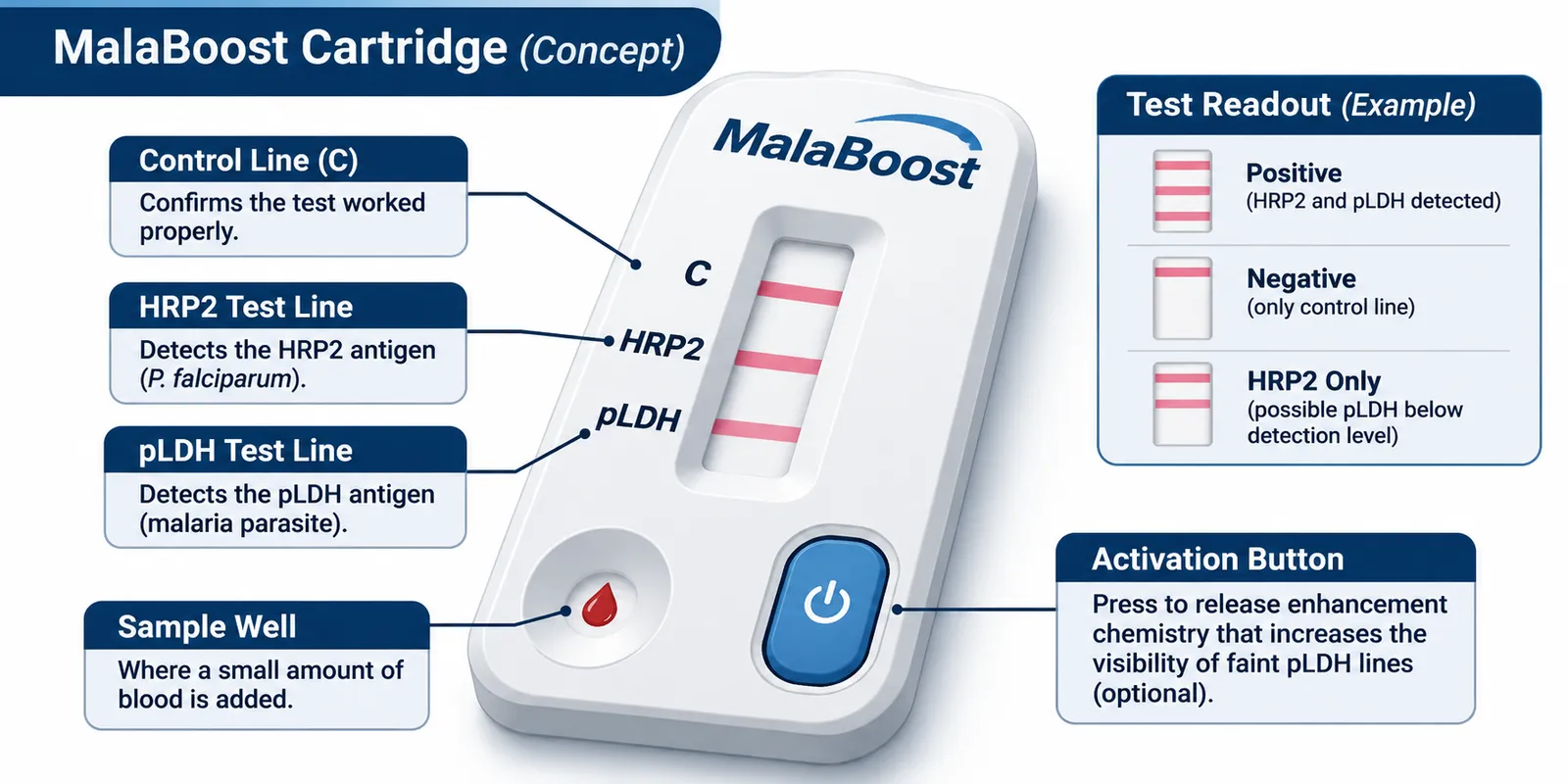
Why reader-free
Electronic readers can resolve faint lines, but they add a device, batteries or charging, calibration and repair to every health post that uses them. The design question here is whether chemistry can do part of a reader’s job on the strip itself, so the test stays something you can carry in a pocket.
Catalytic labels have precedent: porous platinum nanocatalysts enabled naked-eye detection of an HIV antigen at very low concentrations in a different lateral-flow assay. Whether that transfers to pLDH, to whole blood and to a press-activated format is completely open.
Computational model
The core of the design is a contrast argument, so I modelled it. Colour on paper removes light multiplicatively, so stain is best described as optical density. Work through the algebra and something useful falls out: stain that lands evenly everywhere cancels out of contrast completely. It can only make the whole strip darker. The only thing that helps is extra density at the line, in proportion to the antigen there.
Play with it. Every number is a slider, not a measurement.
what you’re looking atThe full contrast model: every parameter is a slider, so you can see when enhancement helps and when it only darkens the strip.
How much colour the captured antigen produces before any enhancement. Low parasite density means a small number.
Extra line density per unit of signal. It scales with captured catalyst, so it adds nothing where there is no antigen.
Colour deposited everywhere by catalyst that bound where it should not. This is the central risk.
Variation in grey level from lighting, paper texture and the reader. Fixed in grey levels.
How white the unstained strip appears.
C = 4.5% · ΔI = 10.1 · SNR = 2.5
C = 20.6% · ΔI = 46.3 · SNR = 11.6
Enhancement turns an unreadable line into a readable one.
- Contrast change
- +16.1 pts
- SNR change
- +9.0
- Readable?
- no → yes
The dollar budget
The design target is a manufactured cost under US$1 per test. Only the baseline below comes from a published source; the three added components have never been estimated. Move them to see how fast the headroom disappears.
Default $0.47: median price of malaria RDTs in Global Fund orders, 2009–2018 (Wittenauer et al., 2022). Not a dual-antigen price.
Platinum nanocatalyst synthesis and conjugation. Unknown.
Sealed substrate and dilute peroxide. Unknown.
Extra manufacturing steps and quality control. Unknown.
$0.72 per test · $0.28 under target
At procurement scale a few cents per test is a large sum, which is why the enhancement must be cheap as well as selective.
the full derivation is in the research brief ↓
Manufacturing economics
The design target is a manufactured cost below US$1 per test. That’s a goal, not an estimate. The only documented number I have is the baseline: Global Fund purchase orders from 2009–2018 put the median malaria rapid test at about US$0.47. Catalyst synthesis and conjugation, the blister, the extra assembly and the quality control all have to fit in what’s left, and none of them has been costed. The budget panel above makes the point: the headroom disappears quickly.
Design trade-offs
Signal vs background
Enhancement only helps if the line gains more than the membrane around it.
Sensitivity vs specificity
Catalyst stuck where it shouldn’t be could colour an antigen-negative strip. That is the central risk.
Benefit vs simplicity
An extra step adds timing errors and needs training on when not to use it.
Benefit vs cost & shelf life
More reagents, a sealed blister and conjugation steps, all in hot storage conditions.
Assumptions and limitations
- The model ignores scattering, membrane non-uniformity and the non-linear response of eyes and cameras.
- It assumes catalytic enhancement scales with captured antigen; that has not been shown for pLDH.
- The “readable” threshold in the model is illustrative, not a measured human visual threshold.
- The planned first experiment uses food dye on paper, which is not antigen on nitrocellulose.
- Any work with human samples would need ethics approval, biosafety procedures and comparison against PCR.
The path to validation
The first step is cheap on purpose: a paper-strip contrast experiment with food-dye dilutions, three treatment arms (no enhancement, colour on the line only, colour on the whole strip), a fixed lightbox, ImageJ grey values and blinded readers. If confined enhancement doesn’t help even in that idealized setup, the idea fails early. After that: background staining, false signals on blank strips, repeatability, blister delivery, shelf stability and reader agreement. None of it has started.
Documents and entries
- Research brief: Catalytic enhancement for faint pLDH lines, with the derivation and references.
- The engineering specification and modelling materials are published on Zenodo, an open research repository (not peer review).
- Interactive lab source on GitHub.
- Entered in the Diamond Challenge and the Blue Ocean competition. Entries, not results.
Research log
Dated entries from the research notebook.
- Nov 13, 2026MilestoneMalaBoost interactive lab
- Nov 2026ChallengeChallenge: a dollar is not much money
- Nov 2026Experiment designPlanned: a paper-strip contrast model
- 2026SubmissionEntered: Diamond Challenge and Blue Ocean